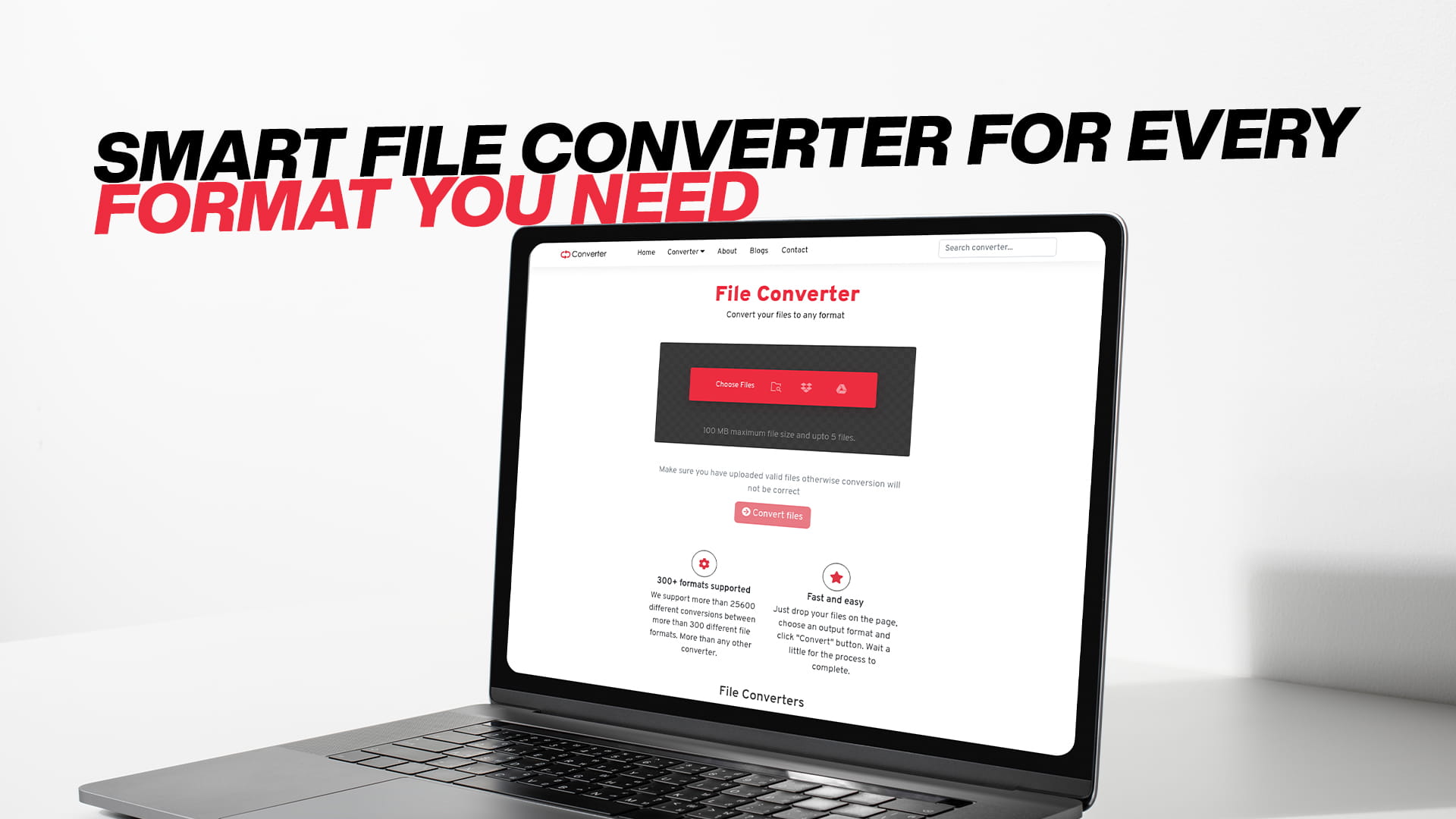
Smart File Converter for Every Format You Need
Every single day, people all over the world run into the same frustrating problem. They have a file — a video, a document, an image, an audio recording — and it simply will not open. The device does not support it. The app does not recognize it. The platform refuses to accept it. The person on the other end cannot read it.
This is not a rare or unusual experience. It happens to students trying to submit assignments. It happens to professionals sending files to clients. It happens to content creators uploading media to different platforms. It happens to everyday people trying to share a video or open a document they just downloaded. File format problems are one of the most universal digital frustrations that exist, cutting across every kind of user, every kind of device, and every kind of task.
The solution is not complicated. What you need is a smart, reliable file converter that understands every major format, handles every major file type, and delivers clean, accurate results without making you jump through hoops. What you need is a tool that works the way you think it should — quickly, simply, and for free.
That tool is Convertio.
This guide is going to walk you through everything you need to understand about smart file conversion. What it is, why it matters, how it works, which formats it covers, and why Convertio stands out as the most sensible, capable, and accessible free file converter available online today.
What It Really Means to Have a Smart File Converter
The word "smart" gets used a lot in the technology world, often without meaning much. But when it comes to file conversion, being smart has a very specific and practical meaning.
A smart file converter does not just handle one type of file. It handles all of them. It does not make you install separate tools for video, different tools for audio, and yet another tool for documents. It brings everything together in one place, recognizes what you need, and gives you exactly that.
A smart file converter is also intuitive. It does not require you to understand the technical differences between container formats, codecs, compression algorithms, or encoding standards. It handles the technical complexity behind the scenes and presents you with a clean, simple experience. You tell it what you have and what you want. It does the rest.
A smart file converter is fast. It does not make you wait minutes for a basic conversion that should take seconds. It processes files efficiently and delivers results promptly so you can get back to what you were actually trying to do.
A smart file converter is also free and accessible. File conversion is a basic digital task. It should not require a subscription, a license fee, or a software download. It should be available to anyone with an internet connection, on any device, at any time.
Convertio meets every one of these standards. It is genuinely smart in all the ways that matter.
The World of File Formats: Why There Are So Many
If you have ever wondered why there are so many different file formats — and why they cause so many problems — the answer lies in how digital technology developed over the decades.
Different file formats were created by different companies, organizations, and communities, each with specific goals in mind. Some formats were designed to minimize file size for easier storage and transmission. Others were designed to preserve maximum quality for professional use. Some were developed as open standards that anyone could use for free. Others were created as proprietary formats tied to specific software or hardware ecosystems.
Over time, as technology evolved and new use cases emerged, new formats were developed to meet new needs. Video formats evolved as screens got sharper and bandwidth increased. Audio formats evolved as streaming replaced physical media. Document formats evolved as digital collaboration became the norm. Image formats evolved as web design and photography drove new requirements.
The result is a landscape of hundreds of formats across different file categories, each with its own strengths, limitations, and compatibility characteristics. And because different devices, operating systems, and applications support different subsets of these formats, compatibility gaps are inevitable.
This is not a problem that is going to go away. The diversity of formats is a permanent feature of the digital world, not a temporary glitch. What changes is how well you are equipped to handle it — and having Convertio as your file conversion tool means you are always equipped.
Image Conversion: Matching Format to Purpose
Images are everywhere in digital life, and they come in more formats than most people realize. Choosing the right image format matters more than many users appreciate, and knowing how to convert between formats is a genuinely useful skill.
JPEG, commonly written as JPG, is the format most people encounter most often. It is the default format for digital photographs and is supported by every device, browser, and application in existence. JPEG uses compression to keep file sizes manageable, making images easy to share and fast to load. The trade-off is that JPEG compression is lossy, meaning a small amount of detail is sacrificed to achieve smaller file sizes.
PNG is the format of choice when quality and transparency matter more than file size. PNG supports transparent backgrounds, which makes it essential for logos, icons, and graphics that need to be placed over different backgrounds. PNG also uses lossless compression, meaning no detail is lost. The result is larger files than JPEG, but with perfect visual fidelity.
WEBP is a modern format developed by Google that has gained enormous traction in recent years, particularly in web development. WEBP delivers smaller file sizes than both JPEG and PNG while maintaining excellent visual quality, making it ideal for websites where fast loading times are a priority. More platforms and browsers are supporting WEBP every year, and it is increasingly becoming the standard for web images.
GIF is the format behind the looping animations that have become a cultural staple of online communication. Its color support is limited, which makes it unsuitable for photographs, but for simple animations and short clips it remains widely used and universally recognized.
TIFF is the professional photographer's and print designer's format of choice. It stores image data without compression, preserving every single pixel at full quality. TIFF files are large, but they are the gold standard when absolute image quality is required.
BMP is an older Windows format that stores image data in raw form with no compression. It is rarely used in modern workflows because of its large file sizes, but it is still encountered occasionally, particularly with older software.
SVG is unique among image formats because it is vector-based rather than pixel-based. Instead of storing a grid of colored dots, SVG stores mathematical instructions for drawing shapes. This means SVG images can be scaled to any size without any loss of quality, making them perfect for logos, icons, and graphics that need to look sharp at any resolution.
ICO is the format used for icons in Windows applications and browser favicon files. Converting a design into ICO format is a specific need that web developers and software developers encounter regularly.
Convertio handles all of these formats and the conversions between them. Whether you need to convert a TIFF photograph to JPEG for easy sharing, turn a PNG logo into SVG for scalable use, convert images to WEBP for a faster website, or any other image conversion task, Convertio delivers the result you need.
Audio Conversion: Sound in Every Format
Audio is another area where format diversity creates real challenges for everyday users. Music lovers, podcasters, voice artists, musicians, and everyday people who just want to listen to a file they received all encounter audio format problems at some point.
MP3 is the format that brought digital music to the masses. Its ability to compress audio files dramatically while maintaining listenable sound quality made it the foundation of the digital music revolution. MP3 is supported by every audio player, every streaming app, every device, and every platform. When universal compatibility is the goal, MP3 is almost always the right choice.
WAV is the opposite of MP3 in many ways. It stores audio in uncompressed form, preserving every detail of the original recording without any quality loss. WAV files are large — significantly larger than MP3 files of the same duration — but they are the standard in professional audio production, music recording studios, and broadcast environments where quality cannot be compromised.
FLAC importantly sits between WAV and MP3. It is a lossless compressed format, meaning it reduces file size significantly compared to WAV while preserving every bit of audio quality. FLAC files sound identical to the original recording, making them a favorite among audiophiles who want the best sound without the storage burden of uncompressed WAV files.
AAC is the audio format that Apple adopted for music purchases on iTunes and as the default recording format for iPhones and iPads. It generally delivers better sound quality than MP3 at equivalent file sizes, making it a popular choice for streaming services and modern mobile audio.
OGG is an open-source audio format known for good quality at small file sizes. It is widely used in games, applications, and Linux-based systems, though it has less universal support than MP3 or AAC on consumer devices.
WMA is Microsoft's audio format, which performs well within the Windows ecosystem but is less compatible outside of it. Many users find themselves needing to convert WMA files to MP3 or AAC for use on non-Windows devices.
AIFF is Apple's uncompressed audio format, equivalent to WAV in quality and used in professional audio production on Mac systems. Like WAV, it preserves complete audio fidelity at the cost of large file sizes.
M4A is the file extension for audio encoded in AAC format within an MP4 container. It is commonly used for music and audiobooks in the Apple ecosystem and offers excellent quality at modest file sizes.
Convertio supports conversion between all of these audio formats. Whether you are preparing audio for a podcast, converting music files for playback on a specific device, turning a high-quality studio recording into a shareable MP3, or handling any other audio conversion task, Convertio handles it cleanly and accurately.
Video Conversion: The Most Complex and Common Need
Of all the file conversion categories, video is the most technically complex and the one where format incompatibilities are most frequently encountered. Video files are large, encode multiple streams of data simultaneously, and come in a bewildering variety of formats with different characteristics.
MP4 has emerged as the dominant video format for general use. Its combination of excellent compression efficiency, broad device compatibility, and solid quality makes it the safest choice for virtually any video sharing or storage purpose. If someone asks you to send a video and does not specify a format, MP4 is almost always what they expect.
MKV is a powerful and flexible video container that can hold video, audio, subtitles, and chapter information in a single file. It is popular for high-definition movies and TV shows precisely because of this flexibility, but its compatibility is not as universal as MP4. Converting MKV to MP4 is one of the most searched video conversion tasks on the internet, and Convertio handles it beautifully.
AVI is one of the oldest video formats in widespread use. It was the dominant format for Windows video in the 1990s and early 2000s and is still encountered frequently in older video collections and archives. While many modern players support AVI, it produces larger files than contemporary formats and is not ideal for web use or mobile playback.
MOV is Apple's native video format, used by iPhone cameras and Final Cut Pro, Apple's professional video editing software. MOV files integrate perfectly with the Apple ecosystem but can be awkward to work with on Windows devices and Android phones. Converting MOV to MP4 is a very common need for iPhone users who want to share videos with non-Apple users.
WMV is Microsoft's video format, which plays smoothly on Windows Media Player and within Microsoft's ecosystem but has limited support elsewhere. Users frequently need to convert WMV files when working with non-Windows editing software or sharing with people on different platforms.
FLV was the dominant format for web video during the era when Adobe Flash was the standard for online video playback. With Flash now obsolete, FLV has largely been replaced by MP4, but older video archives and downloads frequently contain FLV files that need to be converted.
WEBM is a modern open-source video format optimized for web use. It delivers good quality at small file sizes and is natively supported in modern browsers without requiring plugins. Web developers often use WEBM for embedded video content.
3GP is a format designed specifically for mobile phones, particularly older ones with limited processing power and storage. While modern smartphones have moved to MP4, 3GP files are still encountered when dealing with older devices or archives.
AV1 is one of the newest video formats, offering significantly better compression than older standards while maintaining excellent quality. It is increasingly being adopted by streaming services and video platforms as they seek to deliver higher quality at lower bandwidth.
Convertio handles conversion between all of these video formats, giving you the flexibility to work with whatever video files you encounter and deliver them in whatever format your situation requires.
Document Conversion: The Professional Essential
Documents are at the center of professional and academic life. The ability to convert documents between formats quickly and reliably is not just convenient — for many people it is genuinely essential to getting their work done.
DOCX is the format used by Microsoft Word, which remains the most widely used word processing application in the world. Whether or not you use Word yourself, you will almost certainly need to work with DOCX files at some point, because it is the format that employers, clients, schools, and organizations most commonly request.
ODT is the equivalent format for LibreOffice and OpenOffice, which are free and open-source alternatives to Microsoft Office. While ODT is a perfectly capable format, compatibility issues arise when ODT files are opened in Word or when DOCX files are opened in LibreOffice. Converting between these two formats ensures that your documents look exactly as intended regardless of what software the reader uses.
PDF is in a category of its own. Portable Document Format was created specifically to solve the problem of documents looking different on different devices and operating systems. A PDF preserves fonts, layout, spacing, colors, and every visual element of a document exactly as they were created, regardless of what software or operating system opens it. Converting documents to PDF is one of the most common tasks in professional workflows — for contracts, reports, invoices, proposals, presentations, and any other document that needs to look consistent everywhere.
Converting in the other direction — from PDF to an editable format — is also frequently needed. When you receive a contract as a PDF and need to make changes, or when you have a report in PDF form that you need to incorporate into another document, converting it to DOCX or another editable format is the first step. Convertio makes this straightforward.
TXT is the simplest of all document formats — plain text with no formatting. It is universally readable by every text editor and word processor, which makes it valuable for certain purposes, but its lack of formatting means it is not suitable for polished documents. Converting a TXT file to DOCX or another richer format is common when someone wants to add formatting to a plain text document.
RTF, or Rich Text Format, is an older format designed to be compatible across different word processors. It supports basic formatting like bold, italic, and different fonts, but lacks the advanced capabilities of modern document formats.
HTML documents are web pages, but they are also used as a document format in certain contexts. Converting documents to and from HTML is relevant for web publishing, email content creation, and archiving purposes.
Convertio handles all of these document formats and the conversions between them, making it a reliable partner for any professional or academic document workflow.
PDF Tools: Beyond Simple Conversion
PDF deserves more than a passing mention in any serious discussion of file conversion, because it is so central to how documents are shared and preserved in professional contexts.
While creating PDFs from other document formats is one of the most common conversion tasks, there are many other PDF-related operations that people regularly need. Converting a PDF to Word for editing. Converting multiple documents to PDF to create a consistent archive. Extracting content from a PDF to use in another document. Preparing a PDF form for distribution.
Convertio's support for PDF conversion goes in both directions and covers a wide range of source and target formats, making it a genuinely useful tool for PDF-related tasks that go beyond the basic convert-to-PDF operation.
eBook Conversion: Reading What You Want, Where You Want
The eBook market has grown enormously, but it remains fragmented across different ecosystems with different preferred formats. This fragmentation creates real problems for readers who own multiple devices or buy books from different stores.
EPUB is the most widely supported eBook format outside of Amazon's ecosystem. It is the preferred format for Kobo, Nook, Apple Books, and most third-party reading apps. EPUB files are reflowable, which means the text automatically adjusts to fit whatever screen size it is displayed on, making for a comfortable reading experience on devices of all sizes.
MOBI is Amazon's original eBook format, designed for Kindle devices. If you have an EPUB book and want to read it on a Kindle, you need to convert it to MOBI first. This is one of the most common eBook conversion needs, and Convertio handles it cleanly.
AZW3, also known as KF8, is Amazon's newer Kindle format that supports more advanced formatting features than MOBI. More recent Kindle devices and the Kindle app use AZW3 for books with complex layouts.
FB2 is a format popular in Eastern Europe and Russia. It has a structured XML-based design and is supported by many reading apps, particularly on Android. If you source books from international libraries or catalogs, you may encounter FB2 files that need to be converted for your device.
LIT was Microsoft's eBook format, now discontinued but still occasionally encountered in older digital libraries and archives.
PDF is frequently used for eBooks, particularly for textbooks, manuals, and documents that have complex layouts not suited to reflowable formats. However, PDF eBooks do not display well on small e-reader screens because the text does not reflow to fit the screen — instead, you end up zooming and scrolling to read. Converting a PDF eBook to EPUB or MOBI transforms it into something far more comfortable to read on a dedicated e-reader.
Convertio supports all major eBook formats and the conversions between them, making it straightforward to read whatever you want on whatever device you prefer.
Compressed Files: Simplifying Archives
Compressed file archives are a fundamental tool for managing and sharing large collections of files. They bundle multiple files into one and apply compression to reduce the total size, making large collections easier to store, transfer, and share.
ZIP is the most universally supported archive format, handled natively by Windows, Mac, and Linux without requiring any additional software. It is the default choice for sharing file collections in most professional and personal contexts.
RAR is a proprietary archive format that often achieves better compression than ZIP, particularly for certain types of content. RAR files require dedicated software to open, which can create compatibility issues on systems where that software is not installed.
TAR is a format commonly used in Linux and Unix environments. It bundles files together without compressing them, and is frequently combined with GZIP or BZIP2 compression to create compressed archives with extensions like TAR.GZ or TAR.BZ2.
7Z is an open-source archive format with excellent compression capabilities. It is particularly popular among users who frequently share large files and want to minimize their size as much as possible.
GZ, or GZIP, is a compression format commonly used on Linux and Unix systems, often in conjunction with TAR for creating compressed archives.
Convertio supports conversion between these archive formats, which is particularly useful when you receive a file in one archive format and need to work with it in a system that prefers another.
Software Files and Technical Formats
For developers, system administrators, and technically oriented users, Convertio also handles software-related file formats. Disk images, application packages, installation files, and other technical formats sometimes need to be converted between versions or systems. Having a single trusted platform that handles these conversions alongside everyday document, image, and video conversions simplifies the toolset that technical users need to maintain.
The Value of Truly Free Conversion
It is worth pausing to appreciate what it means that Convertio is genuinely free. This is not free-with-limitations, free-for-the-first-five-conversions, or free-but-with-a-watermark-on-your-output. It is simply free — available to everyone, for as many conversions as they need.
Professional tools for handling these kinds of conversions are often expensive. PDF editors, video converters, and professional image processing software can cost significant amounts through subscriptions or one-time purchases. For individuals and small organizations, these costs add up quickly.
Convertio removes the financial barrier entirely. A student converting assignments for submission, a freelancer preparing files for different clients, a small business owner handling everyday document tasks, a teacher preparing materials for class — all of them can access the same powerful, comprehensive conversion capabilities without spending anything.
This matters especially for users in regions where software costs are prohibitive relative to local income levels, for people who only need to convert files occasionally and cannot justify a subscription, and for anyone who believes that basic digital tools should be accessible to everyone regardless of their financial situation. Convertio lives up to that belief.
No Installation, No Registration, No Complications
Two of the biggest practical advantages of Convertio are so straightforward they are easy to overlook.
First, there is nothing to install. Convertio runs entirely in your web browser. You do not download a program, run an installer, grant permissions to an application, or deal with software updates. This means it works on any device — Windows computers, Macs, Linux machines, Chromebooks, Android tablets, iPhones, and anything else with a modern browser and internet access. It also means your system stays clean, without additional software consuming resources or storage.
Second, there is no registration required. You do not need to create an account, verify an email address, choose a password, or hand over any personal information. You go to Convertio, do your conversion, and move on. Your privacy is preserved because you have not given the platform any information about yourself. There is no account to be compromised, no mailing list to be added to, and no profile being built about your usage habits.
These might seem like small things, but they represent a genuinely user-respecting approach to building a digital tool. You are there to convert a file, and Convertio respects that by getting out of the way and letting you do exactly that.
How to Use Convertio: The Simplest Process Possible
The actual process of converting a file with Convertio could not be simpler. Here is exactly what it looks like.
You begin by visiting Convertio. The interface is clean and well-organized, making it immediately clear how to proceed. File categories are clearly presented so you can navigate directly to the type of conversion you need.
You choose your target format — the format you want your file to be converted into. For example, if you have a DOCX file and want a PDF, you select PDF as the output format.
You upload your file. You can select it directly from your computer or device. The file uploads to the platform's servers for processing.
Before converting, you have the option to adjust settings if needed. Many conversions work perfectly with default settings, but for users who want control — over video resolution, audio bitrate, image quality, or other parameters — those options are available.
You click convert, and the platform processes your file. Conversion times vary depending on file size and type, but most conversions complete quickly.
When the conversion is done, you download your converted file directly to your device. The process is complete.
From the moment you arrive at Convertio to the moment you have your converted file downloaded, the entire experience is designed to be as smooth and frictionless as possible. There are no unnecessary steps, no confusing options, and no technical knowledge required.
Getting the Most from Every Conversion
A few practical habits will help you consistently get excellent results from Convertio.
Always start with the best version of your source file. The quality of a converted file is limited by the quality of the original. If you have the option to start from an uncompressed or high-quality version, always use that rather than a previously compressed copy.
Think about the intended use of the converted file before selecting your output format and settings. A video for social media has different optimal settings than one for personal archiving. An image for a website should be optimized for small file size, while one for print should prioritize resolution and quality.
After every conversion, open the output file and check it before deleting the original. This takes only a moment and ensures you catch any issues before they become a problem.
When converting for a specific platform or service, check that platform's recommended format specifications. Most major platforms publish guidelines about preferred formats, resolutions, and file sizes. Matching those specifications ensures the best possible results.
Final Thoughts
The diversity of file formats is a permanent feature of digital life. New formats will continue to emerge as technology evolves, and the gap between what your current files look like and what different devices, platforms, and applications expect will remain a constant challenge. The solution is not to learn the technical intricacies of every format — that is neither practical nor necessary. The solution is to have a smart, capable, and reliable file converter at your fingertips whenever you need it.
Convertio is that converter. It handles images, audio, video, documents, PDFs, eBooks, compressed archives, software files, and more — all from one clean, free, browser-based platform. No installation. No registration. No cost. Just clear, accurate, fast file conversion for every format you need.
Whether you are converting a document for a deadline, preparing media for a specific platform, saving an eBook for a different reader, or handling any other file format challenge, Convertio is ready to help.
Visit Convertio today and experience what smart file conversion actually feels like.